Best Mobile Apps for IELTS Vocabulary Building (2026)
The 7 best mobile apps to build IELTS vocabulary — ranked by retention method, academic register, examiner-rewarded words, and free content.
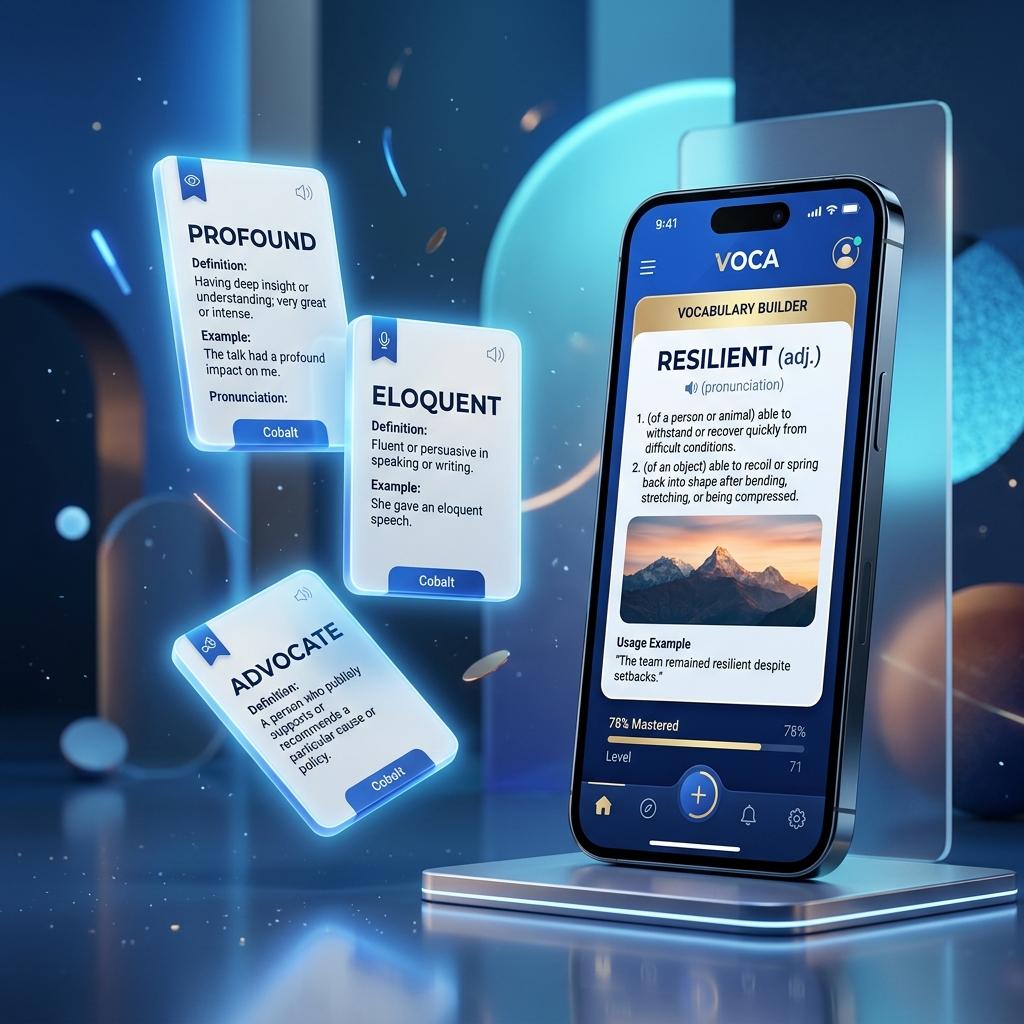
You cannot Band-7 your way out of bad vocabulary. The Lexical Resource column is 25% of your Speaking and Writing score, and it is the dimension where the difference between Band 6.0 and Band 7.0 is almost entirely about which words you know — and whether you can use them precisely.
This guide ranks the best mobile apps for IELTS vocabulary building in 2026 across four criteria:
- Retention method — does it use spaced repetition, or just word lists?
- Academic register — does it teach IELTS-appropriate words, not slang?
- Examiner-rewarded vocabulary — does it include the specific high-band words examiners listen for?
- Free content — what can you use without paying?
The 7 apps worth installing
1. Sprechify (IELTS-focused, in-conversation)
- Method: Vocabulary practised in live spoken conversation; the AI tutor suggests stronger words while you speak
- Pricing: Paid only: Pro $24.99/month ($199/year) or the 30-day course at $129. No free trial.
- Verdict: Tests vocabulary the way the Speaking test does: whether you can use words correctly while talking. IELTS Speaking only.
2. Anki (open-source flashcards)
- Method: Spaced repetition (SM-2 algorithm)
- Free: 100% free on Android, paid one-time on iOS
- Verdict: The gold standard for flashcard retention. You need to build your own deck or download a Cambridge IELTS deck.
3. Quizlet
- Method: Multiple study modes (cards, write, test)
- Free: Generous free tier
- Verdict: Good for beginners. Tens of thousands of public IELTS decks.
4. Magoosh IELTS Vocabulary Flashcards
- Method: Curated 600-word IELTS list with definitions and examples
- Free: Yes
- Verdict: Strong starter list. Limited beyond the 600 words.
5. IELTS Word Power (British Council)
- Method: Themed vocabulary categories
- Free: Yes
- Verdict: Official, basic. Useful for absolute beginners.
6. Memrise
- Method: Mnemonic-driven repetition with native-speaker videos
- Free: Limited free tier
- Verdict: Good for casual learners, less rigorous than Anki.
7. WordUp
- Method: Algorithmic vocab discovery based on usage frequency
- Pricing: Freemium (free version available, premium starting at $6/mo)
- Verdict: Good for general English vocabulary expansion, not IELTS-specific.
What "IELTS vocabulary" actually means
There are three vocabulary categories that move IELTS bands:
- Topic vocabulary — words specific to common IELTS topics (environment, technology, education, health, etc.)
- Functional vocabulary — words for expressing opinions, comparisons, cause-and-effect, hypotheticals
- High-band vocabulary — the precise, single-word alternatives examiners listen for
Topic example: "biodiversity" instead of "different plants and animals" Functional example: "ostensibly" instead of "it seems like" High-band example: "ubiquitous" instead of "very common"
The mistake most apps make is teaching only the third category in isolation. Without context, big words sound forced — and examiners deduct for forced vocabulary.
How to actually build vocabulary that scores
The retention formula that works:
- Encounter the word in a real reading/listening source
- Use the word in a sentence within 24 hours
- Review with spaced repetition over 30 days
- Apply the word in a Speaking or Writing task within 7 days
Flashcards alone (steps 1 and 3) are not enough. You need steps 2 and 4 to make the word stick — and to ensure you can use it correctly under exam pressure.
This is why Sprechify integrates vocabulary into actual conversation: when you use a word with the AI examiner, the system tracks correct usage and re-tests it 3, 7, and 30 days later.
Build vocabulary through real practice
Every Sprechify lesson identifies the 3–5 words that would have moved your answer up half a band. Then it sets a spaced-repetition schedule that brings them back automatically.
See Plans & PricingThe vocabulary mistakes that lose half a band
- Using slang or colloquialisms in Writing ("kinda", "stuff", "like", "you know")
- Repeating the same word five times in one essay
- Using a word you do not fully understand ("notwithstanding" used as "however")
- Overusing one synonym instead of varying ("important" → "crucial" → "vital" → "essential")
- Memorising idioms that sound forced ("It's raining cats and dogs" in an academic essay)
FAQ
How many words do I need to know for IELTS Band 7? Approximately 6,000 active words for Band 7, and 8,000 for Band 8. The 600-word IELTS list is a foundation, not a destination.
How long does it take to learn 1,000 new words? With daily spaced repetition (20 minutes/day), about 6–8 weeks for retention. Longer for active usage.
Is Anki worth the learning curve? Yes if you are targeting Band 7.5+. The interface is unintuitive but the algorithm is unbeatable for retention.
Can I just learn vocabulary from reading? You can — and you should. Reading the Cambridge IELTS book Reading sections in your spare time is the single most efficient way to build passive vocabulary. Active vocabulary still requires spaced repetition.