How to Prepare for IELTS: The Complete 2026 Guide
How to prepare for IELTS at home or with a course: the 8-week framework, a weekly home routine, free resources, and the mistakes that lose half a band.
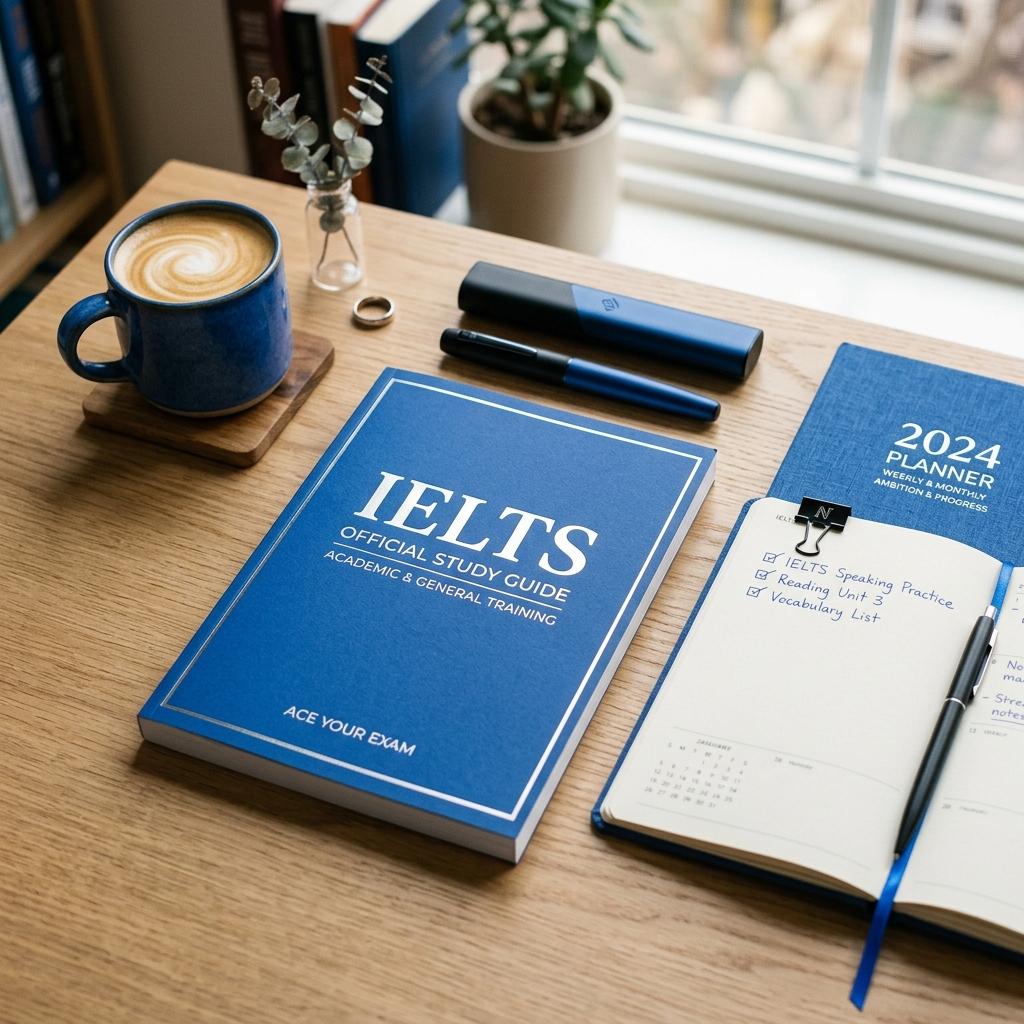
The question "how to prepare for IELTS" gets thirty thousand searches every month. The answers online are either too vague ("practice every day!") or too specific to one section ("here are 50 Part 2 cue cards"). This guide gives you the complete IELTS preparation framework — the diagnostic, the 8-week plan, the test-day playbook — without the fluff.
The 4-step preparation framework
Step 1: Diagnose your starting band
You cannot improve what you cannot measure. The first thing to do — before opening any prep book — is to take a real timed practice test and score yourself honestly.
Options:
- IDP IELTS Prepare (free): One full computer-based mock test
- Cambridge IELTS Book 18 (paid, ~$25): Four full mocks, official answer keys
- Sprechify placement (free, pricing plans): Five-minute voice diagnostic + projected band
Your starting band determines your plan length:
- Band 4–5 starting: 12 weeks to reach Band 6.5
- Band 5–6 starting: 8 weeks to reach Band 7.0
- Band 6–6.5 starting: 6 weeks to reach Band 7.0
- Band 6.5+ starting: 4 weeks to reach Band 7.5
Step 2: Identify your weakest section
The median IELTS candidate is 0.5–1.0 band lower on their weakest section than their best. Your prep time should be weighted accordingly:
- 50% on your weakest section
- 30% on your second-weakest section
- 10% each on the two stronger sections
Most candidates make the opposite mistake — they over-practise their strongest section because it feels good.
Step 3: Build a daily habit
Practise every day. Frequency matters more than marathon sessions: a short daily session beats one long session a week, because skills like speaking fluently improve through repetition.
- Aim for 25–30 minutes of focused practice a day
- Protect a fixed time slot so it actually happens
- Speak out loud every day, even on days you focus on another section
Step 4: Run mock exams in the final 2 weeks
The last two weeks of any IELTS prep should be:
- 3 full mocks under real timing (one per 3–4 days)
- Detailed error review after each
- No new material; only revision of weak spots
The 8-week IELTS preparation plan
Weeks 1–2: Foundation
- Master the format of all 4 sections
- Memorise the band descriptors (read them three times each)
- Build vocabulary on 8 core IELTS topics (environment, education, health, technology, society, culture, work, urbanisation)
Weeks 3–4: Skill drilling
- Speaking: SPSE framework for Part 2 (Statement-Point-Support-Extend)
- Writing: Master Task 1 structure and Task 2 essay types
- Reading: T/F/NG and matching headings (the hardest question types)
- Listening: Sections 1 and 2 daily drills
Weeks 5–6: Integration
- Speaking: Part 3 abstract discussion + hypotheticals
- Writing: Task 2 lexical range workshop
- Reading: Summary completion + multiple choice
- Listening: Sections 3 and 4 (academic content)
Weeks 7–8: Mock exams
- Three full timed mocks
- Section-level error review
- Final calibration of pacing and stamina
Preparing for IELTS at home, without coaching
You can do all of the above at home. Most of what a coaching centre provides is structure, materials and feedback. You can get the first two for free and pay only for feedback.
The minimal home toolkit
- A phone or laptop with a microphone, and headphones
- Cambridge IELTS 17 or 18, plus the free official practice material from IDP and the British Council
- A daily 25-minute slot you protect
- A feedback source for Speaking and Writing (see below)
A weekly rotation that covers every section
| Day | Focus | What to do |
|---|---|---|
| Mon | Speaking Part 1 | Record yourself answering 5 personal questions |
| Tue | Reading | One Cambridge passage, timed (20 mins) |
| Wed | Writing Task 1 | One graph, table or process answer |
| Thu | Speaking Part 2 | One cue card under real timing (1 min prep, 2 mins talking) |
| Fri | Listening | One Cambridge section plus transcript review |
| Sat | Writing Task 2 | One full 40-minute essay |
| Sun | Review | Re-read your weakest essay; re-listen to your weakest recording |
That is about three hours a week, or more than 20 hours over 8 weeks.
Getting feedback without a teacher
- Reading and Listening: self-grade against the official answer keys.
- Speaking: record yourself and check against the four descriptors, or practise with a conversational AI tutor such as Sprechify, which is built only for IELTS Speaking.
- Writing: a teacher, an IELTS Writing grader, or peer review in IELTS study communities. The quality of free peer feedback varies.
Staying accountable: the same time every day, a visible tracker (cross off each day on a calendar), one full Speaking and Writing task every Sunday to measure progress, and ideally a study partner.
Practise the Speaking section out loud
Sprechify is a live voice AI tutor for IELTS Speaking: a 30-day course of daily one-hour sessions through Parts 1, 2 and 3 and full mock tests, with feedback on all four Speaking Band Descriptors.
See Plans & PricingThe 12 mistakes that lose half a band
- Skipping the diagnostic and "starting" without knowing your band
- Spending more time on your strongest section
- Watching IELTS tips on YouTube without practising
- Memorising answers that examiners detect as rehearsed
- Practising only when you feel like it (not daily)
- Writing essays without rubric-aligned feedback
- Reading every Reading passage end-to-end (you do not have time)
- Ignoring Speaking until the last week
- Avoiding Writing Task 1 because it feels boring
- Booking the test before you know your current band
- Skipping mock exams because they take 3 hours
- Believing "secret tip" content over the official rubric
The test-day playbook
The night before:
- 7–8 hours of sleep
- Pack: ID, water bottle, pencil case
- Confirm your centre address
The morning of:
- Eat a real breakfast (the test is 3 hours)
- Arrive 30 minutes early
- Do not study — review only
In the test:
- Listening: Read questions before each section plays
- Reading: Skim each passage first (3 mins), then attack questions
- Writing: 20 mins Task 1, 40 mins Task 2 — set a watch alarm
- Speaking: Greet the examiner warmly, breathe before each answer
FAQ
How long does it take to prepare for IELTS? It depends on how far you are from your target. Eight weeks of daily practice is a sensible plan for most candidates aiming to gain half a band to a band.
Can I prepare for IELTS in 1 month? Yes if you are within 0.5 bands of your target. Probably not if you are 1.0+ bands away.
What is the best way to prepare for IELTS at home? A structured daily plan plus outside feedback on Speaking and Writing. See "Preparing for IELTS at home, without coaching" above.
Do I need a tutor to prepare for IELTS? Most candidates do not. Official practice material, daily practice and a reliable source of feedback can take you a long way. Tutors help most for candidates with severe pronunciation or grammar issues.