How to Prepare for IELTS General Training (2026 Complete Guide)
Complete guide to preparing for IELTS General Training. Section format, differences from Academic, target bands for migration, and the 8-week prep plan.
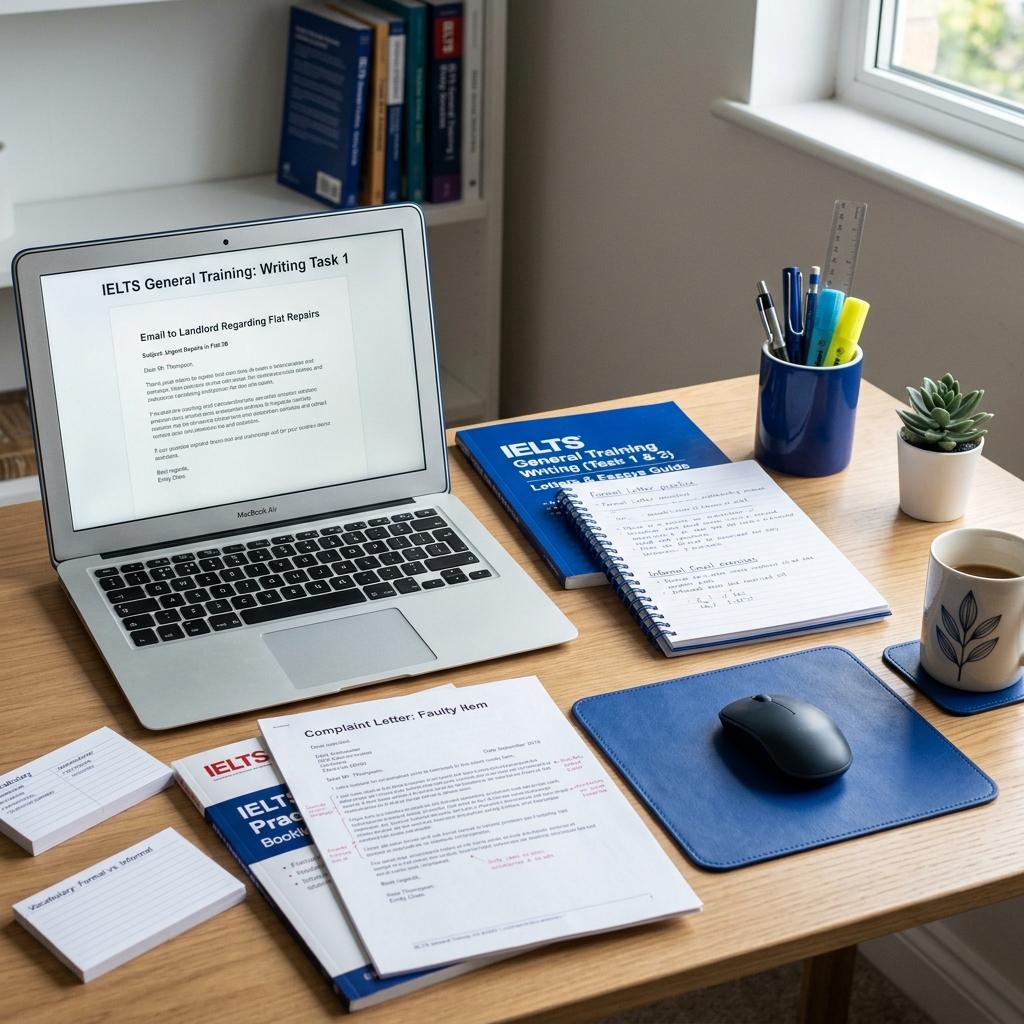
IELTS General Training is the test most migration applicants take — for UK skilled worker visas, Canadian Express Entry, Australian PR, and New Zealand work visas. It is easier than the Academic test in Reading and Writing, but the Speaking and Listening sections are identical. This guide explains how to prepare for IELTS General Training specifically.
How General Training differs from Academic
| Section | Academic | General Training |
|---|---|---|
| Listening | Identical | Identical |
| Reading | Academic passages (journals, books) | Workplace, public notices, magazine articles |
| Writing Task 1 | Describe a chart/graph/process | Write a letter (formal/semi-formal/informal) |
| Writing Task 2 | Essay on abstract topic | Essay on practical topic |
| Speaking | Identical | Identical |
| Overall difficulty | Higher (Reading + Task 1) | Lower (more accessible content) |
The four sections, prep-by-prep
Listening (identical to Academic)
40 questions, 30 mins, 4 recordings of mixed accents (UK, AU, NZ, US).
Prep priorities:
- Section 1 (form completion): drill number/date/spelling capture
- Section 4 (lecture): note-taking shorthand
- All sections: read questions before each recording plays
Reading (easier than Academic)
40 questions, 60 mins, 3 passages.
- Passage 1: 2–3 short workplace/everyday texts (workplace notices, advertisements)
- Passage 2: 1–2 workplace-related texts (job descriptions, training materials)
- Passage 3: 1 longer general-interest text (similar in difficulty to easier Academic passages)
The earlier passages are deliberately easier — bank 35+ correct answers across the first two passages, then attack Passage 3 with the remaining time.
Writing Task 1: Letter (Academic uses charts)
You write a 150-word letter in one of three tones:
- Formal: To someone you do not know (bank manager, government office)
- Semi-formal: To a colleague, distant relative, or service provider
- Informal: To a friend or close family member
Common letter purposes: complaint, request, invitation, apology, explanation.
Structure that scores:
- Opening (10 words): Greeting + reason for writing
- Bullet point 1 (50 words)
- Bullet point 2 (50 words)
- Bullet point 3 (30 words)
- Closing (10 words): Appropriate sign-off for the tone
Writing Task 2: Essay (practical topic)
Same format as Academic Task 2 but with more accessible prompts:
- "Should children be allowed to use mobile phones in school?"
- "Is it better to live in a house or an apartment?"
- "What are the pros and cons of working from home?"
The same SPSE-style structure applies (intro, two body paragraphs, conclusion).
Speaking (identical to Academic)
11–14 mins, 3 parts. Identical format and scoring criteria across both test types.
The 8-week General Training plan
| Week | Reading | Listening | Writing | Speaking |
|---|---|---|---|---|
| 1 | Passage 1 structure | Section 1 forms | Letter formats | Part 1 personal Qs |
| 2 | Passage 2 workplace | Section 2 monologues | Formal letter | Part 1 vocab stretch |
| 3 | Passage 3 long text | Section 3 discussions | Semi-formal letter | Part 2 cue cards |
| 4 | T/F/NG drills | Section 4 lectures | Informal letter | Part 2 SPSE |
| 5 | Matching headings | Accent training | Task 2 opinion essay | Part 3 discussion |
| 6 | Mixed Reading | Distractor traps | Task 2 discussion | Part 3 hypotheticals |
| 7 | Full Reading mocks | Full Listening mocks | Full Writing mocks | Full Speaking mocks |
| 8 | Calibration | Calibration | Calibration | Calibration |
Target bands for major migration programmes
| Programme | Overall band | Section minimums |
|---|---|---|
| UK Skilled Worker visa | 4.0 (CEFR B1) | Varies |
| Canadian Express Entry (CLB 9) | Not used (CLB is set per skill) | Listening 8.0; Reading, Writing and Speaking 7.0 |
| Canadian Express Entry (CLB 7) | Not used (CLB is set per skill) | 6.0 in each |
| Australian PR (Subclass 189) | 6.0+ | Varies |
| Australian PR (Skilled Independent) | 6.0–8.0 | 6.0 minimum |
| New Zealand skilled migrant | 6.5 | 6.5 in each |
Always check the latest requirements on the official immigration site for your destination country. (For UK family visas, settlement and citizenship, the requirement is often IELTS Life Skills, a separate Speaking and Listening test.) For Canada, see IRCC's language test equivalency tables (checked 2 October 2026) and our IELTS vs CELPIP Speaking comparison. Note that Canada does not accept IELTS One Skill Retake for Express Entry.
Sprechify supports General Training format
The Writing module includes letter-writing practice in all three tones. The Reading module includes workplace and everyday passages.
See Plans & PricingCommon General Training mistakes
- Treating Task 1 like the Academic task — writing about data instead of writing a letter
- Using the wrong tone — formal language in an informal letter (or vice versa)
- Skipping the early Reading passages because they "look easy" — bank those points first
- Practising only with Academic materials — the Task 1 format is completely different
- Targeting Band 8 without checking requirements — most GT candidates need Band 6.0–7.0, not higher
FAQ
Is General Training easier than Academic IELTS? Yes — the Reading passages are more accessible and Writing Task 1 is a letter (easier than describing data). Listening and Speaking are identical.
Can I take Academic if my visa only requires General? Yes, but it is harder. Most candidates take whatever the requirement specifies — switching upward is rarely useful.
Is the Speaking test the same band scoring for both? Yes. A Band 7 in Speaking represents the same proficiency regardless of which test type you took.
Can I use General Training results for university? Almost never. Universities require Academic. Always check the institution's specific requirement.