IELTS Speaking Test 2026: Format, Timing, Band Scores & How to Do a Mock Test
Everything about the IELTS Speaking test in 2026 — the three-part format, exact timing, how the band score is calculated, what examiners look for, and how to run a realistic mock test at home with an AI tutor.
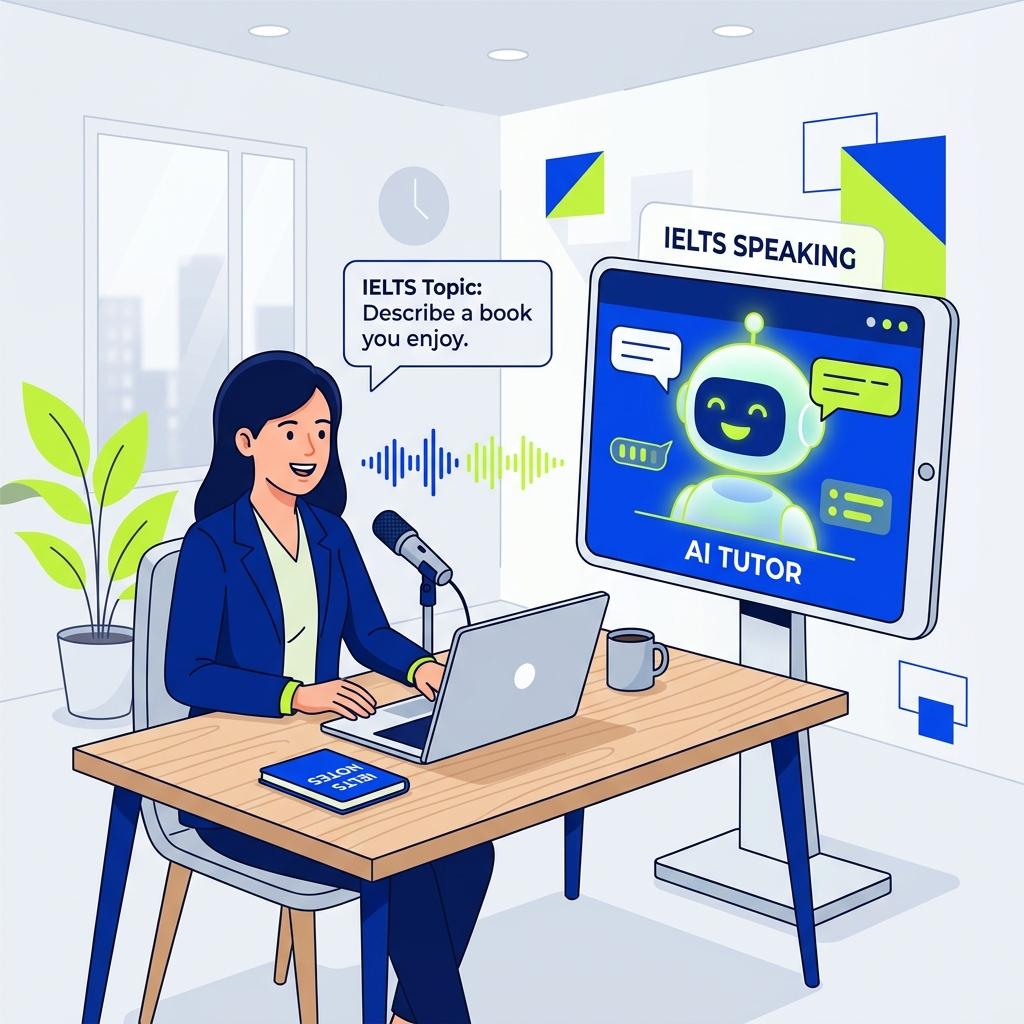
The IELTS Speaking test is the part candidates fear most — and the part that is easiest to prepare for, once you understand exactly how it works. This is the complete 2026 guide to the IELTS Speaking test: the format, the timing, how your band score is actually calculated, and how to run a realistic mock test at home.
By the end of this guide you will know precisely what the examiner is listening for on the other side of the table.
What is the IELTS Speaking test?
The IELTS Speaking test is a face-to-face conversation with a certified examiner that lasts 11–14 minutes. It is the same for IELTS Academic and IELTS General Training, and identical across IDP, British Council, and IELTS USA test centres. It is recorded, and it is the only part of IELTS marked by a human in the room with you.
It has three parts.
IELTS Speaking format and timing
| Part | Name | Time | What happens |
|---|---|---|---|
| Part 1 | Introduction & Interview | 4–5 min | The examiner asks short questions on 2–3 familiar topics (home, work, hobbies). |
| Part 2 | The Long Turn (cue card) | 3–4 min | You get a cue card, 1 minute to prepare, then speak for 1–2 minutes uninterrupted. One follow-up question. |
| Part 3 | Discussion | 4–5 min | Abstract two-way discussion linked to your Part 2 topic. |
The whole test is over in under a quarter of an hour. That is part of what makes it so high-stakes: there is no time to recover from a bad start, which is why practising the format until it is automatic matters so much.
How the IELTS Speaking band score is calculated
Your Speaking band is the average of four equally weighted criteria — the official IELTS Band Descriptors. Each is worth 25%:
1. Fluency & Coherence (25%)
Can you speak at length without unnatural pauses, and connect your ideas logically? Examiners listen for hesitation, self-correction, and whether you use linking words naturally. This is where anxiety does the most damage.
2. Lexical Resource (25%)
The range and precision of your vocabulary. Band 7+ requires "less common" vocabulary and some idiomatic language used accurately. Repeating "good", "bad", and "important" caps you at Band 6.
3. Grammatical Range & Accuracy (25%)
A mix of simple and complex structures, with a good proportion of error-free sentences. Band 7 means you "frequently produce error-free sentences"; Band 8 means the majority are error-free.
4. Pronunciation (25%)
How easy you are to understand. This is not about having a native accent — examiners are explicitly trained not to penalise accent. It is about clarity: individual sounds, word stress, sentence rhythm, and intonation.
Your four scores are averaged and rounded to the nearest 0.5. So a 7, 7, 6, 7 averages to 6.75, which rounds up to 7.0. A 6, 7, 6, 6 averages to 6.25, which rounds down to 6.5. Half a band in one criterion can swing your whole result — which is why diagnosing your weakest criterion early matters more than general practice.
What examiners are actually trained to do
A few things candidates rarely know:
- Examiners follow a script for the questions but score from memory and notes. They are not ticking boxes live; they form an impression across the whole test.
- They are trained to detect memorised answers. A rehearsed Part 2 that does not quite fit the cue card is obvious, and it caps your Fluency score.
- They will not react to your content. If you say something they disagree with, their face will not change. Candidates often misread this neutrality as disapproval and panic. Don't.
- Silence is normal. Examiners pause 2–3 seconds between questions. That pause is not judgement. Do not rush to fill it.
How to do an IELTS Speaking mock test at home
A mock test is the single highest-value preparation activity in the final two weeks. Here is how to run one realistically:
Option 1: Self-recorded mock
- Set a timer and follow the exact format: 4 min Part 1, 1 min prep + 2 min Part 2, 4 min Part 3.
- Record yourself on your phone.
- Use a question bank (see our IELTS Speaking questions and topics) so you do not see the questions in advance.
- Listen back and score yourself against the four criteria above. Be brutal about hesitation and repetition.
The weakness: you cannot easily hear your own grammar slips, and you have no calibrated band score.
Option 2: AI mock test (recommended)
An AI speaking tutor runs the full three-part mock under real timing, then scores you against the four Band Descriptors with an estimated band for each one. The advantages:
- Consistent scoring every time, against the same four descriptors.
- Per-criterion breakdown so you know whether it's Pronunciation or Lexical Resource dragging you.
- Unlimited repetition — do three full mocks a day with no scheduling and no cost per session.
- No human watching, which is exactly what anxious candidates need in the lead-up.
Option 3: Human mock with a tutor
The gold standard for realism, but expensive ($40–80/hour) and limited by scheduling. Most candidates use AI mocks daily and book one human mock near the end as a final check.
A two-week mock test schedule before your IELTS
- Days 1–7: One full AI mock per day. Note your weakest criterion. Drill it for 10 minutes after each mock.
- Days 8–12: Two mocks per day, alternating topic categories. Focus on Part 2 timing and Part 3 depth.
- Days 13–14: One relaxed mock per day. Stop drilling new material. The goal now is to make the test feel boring, not to cram.
By test day, you should have sat the IELTS Speaking test more times than most candidates do in their lives. The real thing should feel like the least novel English conversation you have had all month.
Practise the real format with an AI tutor
Sprechify is built only for IELTS Speaking. Its AI tutor runs the exact three-part format under real timing, scores every answer against the official IELTS Band Descriptors, and shows your projected band per criterion so you know exactly where you stand before you book the test.
Related reading: IELTS Online and video-call Speaking · IELTS Speaking questions and topics 2026 · IELTS One Skill Retake for Speaking · IELTS Speaking Part 2 cue cards · How to stop going blank in Part 2 · Free IELTS Band Estimator