IELTS Speaking Band Descriptors Explained: All 4 Criteria, Band 5 to 9 (Plain English)
The IELTS Speaking band descriptors in plain English: how IELTS Speaking is marked, what each criterion means (fluency, vocabulary, grammar, pronunciation), and a band 5–9 score chart with examples.
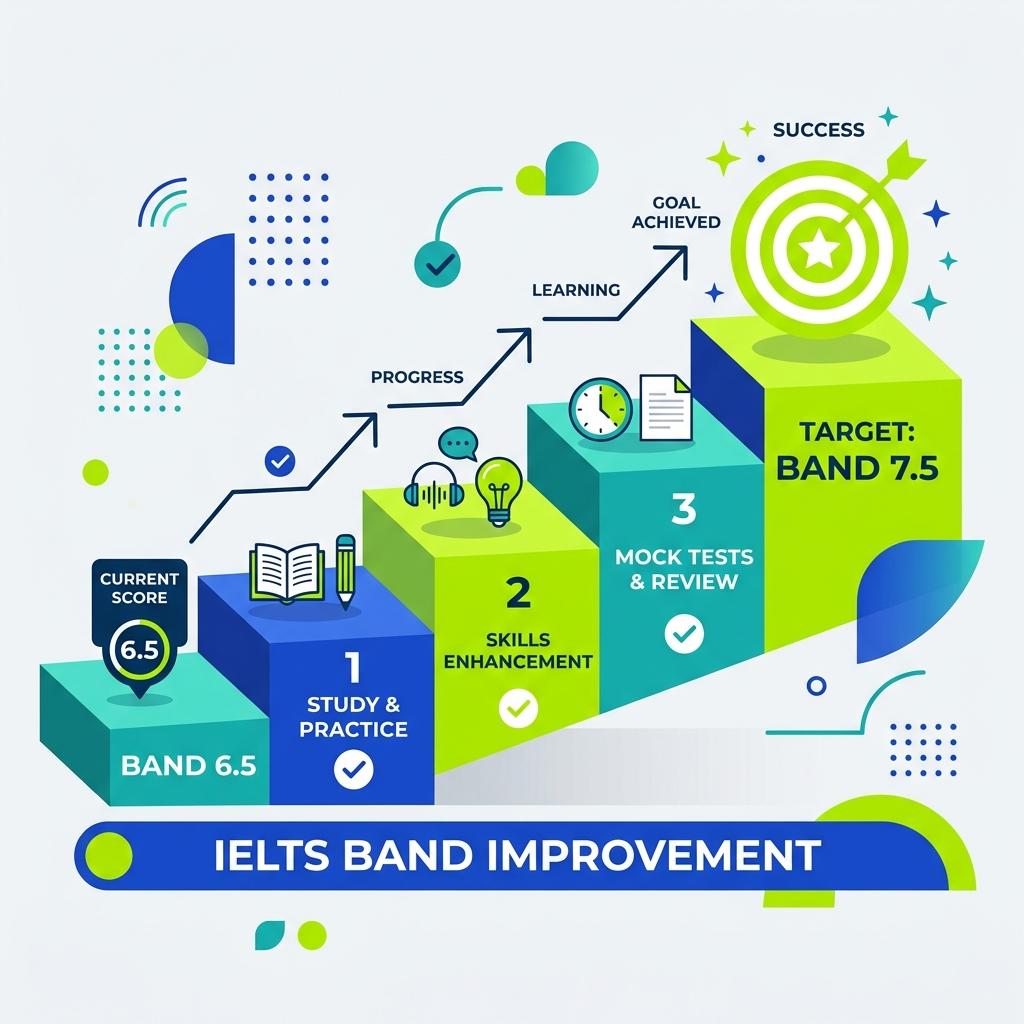
The IELTS speaking band descriptors are the rulebook your examiner uses. If you understand them, you stop guessing what "good speaking" means and start practising what's actually scored. This guide explains the speaking band descriptors in plain English: each criterion, what separates band 5 from band 9, and how your score is calculated.
The official document is the IELTS speaking public band descriptors, published by the IELTS partners. Candidates search for the IELTS speaking band descriptors British Council version and the IELTS speaking band descriptors IDP version, but they're the same: one IELTS speaking band descriptors public version, last revised in 2023. What follows summarises it. Any IELTS speaking band descriptors 2026 list you see online is the same public version.
How IELTS Speaking is marked
How IELTS speaking is marked, in five facts:
- A trained human examiner assesses you. IELTS Speaking is not marked by AI. The examiner goes through regular IELTS speaking examiner training and certification to mark consistently.
- There are four criteria, each marked from 0 to 9.
- The criteria are weighted equally. Your Speaking band is the average of the four, reported in whole or half bands.
- The whole test is assessed, not each answer separately. Parts 1, 2 and 3 all contribute to each criterion.
- The same criteria apply to Academic and General Training. There are no separate IELTS general speaking band descriptors. The IELTS general training speaking band score and the IELTS speaking band score academic are marked identically.
That's how IELTS speaking is scored, and how IELTS speaking score is calculated. Put simply, how is IELTS speaking score decided? Four judgements, averaged. How IELTS speaking score is evaluated in practice: the examiner listens across all three parts, forms a view on each criterion, and checks it against the descriptors.
Is IELTS speaking marked immediately? The examiner rates your performance during and straight after the test. You don't hear your score on the day; it arrives with your full results. The test is also recorded, which is what makes remarking possible.
This is the whole IELTS score structure for Speaking. For the full test, your overall band averages Listening, Reading, Writing and Speaking. The IELTS speaking criteria marking described here only covers the Speaking section.
The four IELTS Speaking criteria explained
Here are the IELTS speaking criteria explained, one at a time. These are the IELTS speaking criteria band descriptors columns. They are the IELTS speaking score criteria on every examiner's sheet.
1. Fluency and coherence
Fluency and coherence meaning: can you speak at length, smoothly, with ideas that connect logically?
- Fluency = continuous speech without hesitating to find words or grammar.
- Coherence = logical organisation, clear development, and natural linking.
The coherence meaning in IELTS speaking is not about fancy connectors. It's whether the examiner can follow your reasoning without effort. Fluency and coherence IELTS examiners hear the difference between hesitating to think (fine at every band) and hesitating to find language (penalised).
For drills on fluency and coherence in IELTS speaking, read how to improve IELTS speaking fluency. It covers IELTS speaking fluency and coherence in depth.
2. Lexical resource
Lexical resource meaning in IELTS: the range, precision and flexibility of your vocabulary. The descriptors look at:
- Range: can you talk about many topics without running out of words?
- Precision: do you choose the exact word, not just a general one?
- Less common and idiomatic items: used naturally and correctly (band 7+).
- Paraphrase: can you explain something another way when you lack the word?
Lexical resource is not about rare words. A precise everyday word beats an impressive wrong one. IELTS speaking vocabulary band 7 is about flexibility; see IELTS speaking idioms and phrases for how idioms fit in. (Short version: IELTS speaking idioms for band 7 help only when natural.)
3. Grammatical range and accuracy
IELTS speaking grammatical range and accuracy has two halves:
- Grammatical range: the variety of grammatical structures you use (simple, compound and complex sentences, a range of tenses, conditionals, relative clauses, passives).
- Accuracy: how many of your sentences are error-free, and whether errors get in the way of meaning.
Grammatical range and accuracy are balanced. Range without accuracy doesn't reach band 7; accuracy with only simple sentences doesn't either. Lexical resource grammatical range often improve together. So do coherence lexical resource and grammar, because precise vocabulary needs the right structures to carry it.
4. Pronunciation
IELTS speaking pronunciation is about intelligibility and control, not accent. The IELTS speaking pronunciation features in the descriptors are:
- Individual sounds: vowels and consonants clear enough to understand.
- Word stress: the right syllable (deVELop, not DEvelop).
- Sentence stress and rhythm: stressing key words, reducing others.
- Intonation: pitch that signals meaning (questions, contrast, certainty).
- Connected speech: linking words naturally.
Good enough pronunciation for band 7+ means being easy to understand throughout, with your accent having little or no effect on clarity. Accent itself is not marked; see does accent affect your IELTS speaking score?. For English pronunciation practice, see Sprechify's pronunciation coaching.
IELTS speaking band score chart: band 5 to 9
Here is the IELTS speaking band score chart, a plain-English IELTS speaking criteria table summarising the public descriptors. Use it as an IELTS speaking score chart, an IELTS speaking score table, or an IELTS band score chart for speaking to find where you are. Think of it as a band score table for Speaking. Each row is the IELTS speaking score description for that band. Each column shows the IELTS speaking band score criteria for one skill.
| Band | Fluency & coherence | Lexical resource | Grammatical range & accuracy | Pronunciation |
|---|---|---|---|---|
| 9 | Fluent; hesitation only to plan ideas; fully coherent | Total flexibility and precision; natural idiomatic language | Precise, accurate structures throughout | Full range of features; effortless to understand |
| 8 | Fluent; rare repetition; hesitation mostly about content | Wide, flexible range; skilful less common and idiomatic items | Wide range; majority of sentences error-free | Wide range of features; easy to understand; accent has minimal effect |
| 7 | Speaks at length without noticeable effort; some language-related hesitation | Flexible; some less common and idiomatic items; effective paraphrase | Range of complex structures; frequent error-free sentences | Positive features of band 6 and some of band 8 |
| 6 | Willing to speak at length; coherence may slip with hesitation or repetition | Enough vocabulary to discuss topics at length; paraphrase usually works | Mix of simple and complex; errors in complex structures rarely block meaning | Range of features, mixed control; generally understood |
| 5 | Keeps going but relies on repetition, self-correction or slow speech | Manages familiar topics; limited flexibility | Basic forms fairly accurate; complex structures limited | Some band 6 features, but listener has to work at times |
IELTS speaking band scores explained, level by level
Band 5 ("modest user"): you can communicate on familiar topics, but with visible effort. IELTS speaking score 5 usually means short answers and a lot of repetition. So is 5.5 IELTS score good? For some college courses and visas it's enough. For most universities it isn't.
Band 6 ("competent user"): the IELTS speaking band 6 description is someone who speaks at length but loses control in complex language. An IELTS speaking score 6 is the most common result worldwide. The difference between band 5 and band 6 is mainly length and willingness: band 6 speakers extend their answers. How to get IELTS speaking band 6: answer every question with at least two or three sentences, and stop avoiding topics.
The IELTS speaking band 6.5 description isn't a separate descriptor. A 6.5 means your four criteria average between 6 and 7 (for example, 7 for fluency and 6 for grammar).
Band 7 ("good user"): the IELTS speaking band 7 description is effortless length, with flexible vocabulary. Band 7 IELTS speaking is the target for most universities and many work visas. The gap in band 6 and band 7 is effort: at 7 the listener can't hear you working.
Band 8 ("very good user"): the IELTS band 8 meaning is wide, flexible, mostly error-free language. The IELTS speaking band 8 criteria allow only occasional inaccuracy. An IELTS speaking band score 8 usually meets any requirement.
Band 9 ("expert user"): the IELTS speaking band 9 descriptors require precision and flexibility throughout. See how to get band 9 in IELTS speaking for what IELTS speaking band 9 answers sound like.
What is a good IELTS score?
What is a good IELTS score depends on your goal. Is 7 a good score in IELTS? Yes: it's a "good user" level that meets most university and professional requirements. Is 7 IELTS score B1 or B2? Neither. IELTS 7.0 is broadly equivalent to CEFR C1. Scores of 5.5–6.5 correspond roughly to B2, and 4.0–5.0 to B1.
How your IELTS speaking score is calculated: a worked example
Here is an IELTS speaking band score breakdown for a typical candidate:
| Criterion | Band |
|---|---|
| Fluency & coherence | 7 |
| Lexical resource | 6 |
| Grammatical range & accuracy | 6 |
| Pronunciation | 7 |
| Average → Speaking band | 6.5 |
That's IELTS speaking score to band conversion: average the four. It's also the IELTS speaking band score explanation for why a single weak criterion can hold you at 6.5 even when two criteria are at 7. An IELTS speaking band score calculator or IELTS speaking score calculator does this arithmetic. A band score calculator IELTS tool for the full test does the same across four skills. The hard part is estimating each criterion honestly.
This worked example is also the best IELTS speaking band score description for strategy: find your lowest criterion and fix it first. It's the fastest route to how to improve IELTS speaking score. The same idea runs through all band 5, band 6 and band 7 advice: the band scores are a profile, not a single number.
There's no official IELTS speaking score sheet for candidates. Examiners use internal forms, and you only receive the final speaking score. That's why a criterion-level IELTS band score for speaking from practice matters.
How to use the descriptors to practise
The IELTS speaking test descriptors are most useful as a practice checklist:
- Record a full mock test.
- Score yourself on each criterion using the chart above. Be honest.
- Pick the lowest criterion and focus on it for two weeks.
- Re-record and re-score.
For self-scoring, an outside view helps. An IELTS speaking band score checker or an AI tool can give you a criterion-level estimate. An IELTS speaking assessment AI is useful for volume and consistency. An AI IELTS speaking examiner can run unlimited mock tests. But the official score always comes from a human examiner, so treat AI estimates as practice data. See how accurate are AI IELTS speaking scores? for an honest look.
Sprechify's AI examiner scores every answer against all four criteria, the same IELTS speaking band criteria in the chart above. You always know which criterion to work on. For a quick starting point, the free band estimator needs no account. It's an honest alternative to a free IELTS speaking test with score that doesn't explain its scoring.
See your score on all four criteria, not just one number.
Sprechify's live AI examiner rates fluency, vocabulary, grammar and pronunciation separately on every answer, so you know exactly what's holding your band back.
Try an AI mock testCommon misunderstandings about the descriptors
- "Accent is marked." It isn't. Intelligibility is. See the IELTS speaking criteria British Council and IELTS speaking criteria IDP pages: accent only matters when it affects clarity.
- "Idioms guarantee band 7." They don't. The descriptors reward natural, accurate idiomatic language.
- "Long answers always score higher." Only if they stay coherent. Rambling hurts coherence.
- "Part 3 counts more." There are no part weights; each criterion is judged across the whole test. The IELTS speaking criteria assessment is holistic.
- "The public version is simplified." The IELTS speaking criteria public version is the same scale examiners use, in candidate-friendly wording.
FAQ
Where can I find the official IELTS speaking band descriptors? On the IELTS partners' websites (British Council, IDP, Cambridge), as the public version. Our chart summarises the IELTS speaking band score descriptors in plain English.
Are the band descriptors the same for all three parts? Yes. The same band descriptors apply across Parts 1, 2 and 3.
Can I get different scores on each criterion? Yes. That's normal, and it's why your band can be x.5.
How do I know my score on each criterion? The official result only gives your overall Speaking band. For IELTS speaking how to score practice, record mocks and score them against the chart. Or use an AI examiner that reports all four criteria.
Next steps: read the Part 1 questions and answers, check your level with the free band estimator, or see plans for full AI mock tests. Every paid plan has a 30-day money-back guarantee.