How to Get Band 9 in IELTS Speaking: What Examiners Actually Reward (2026)
How to score band 9 in IELTS Speaking: the band 8 vs band 9 descriptors, sample answers, pronunciation and fluency tips, and a practice plan. Written from the official criteria.
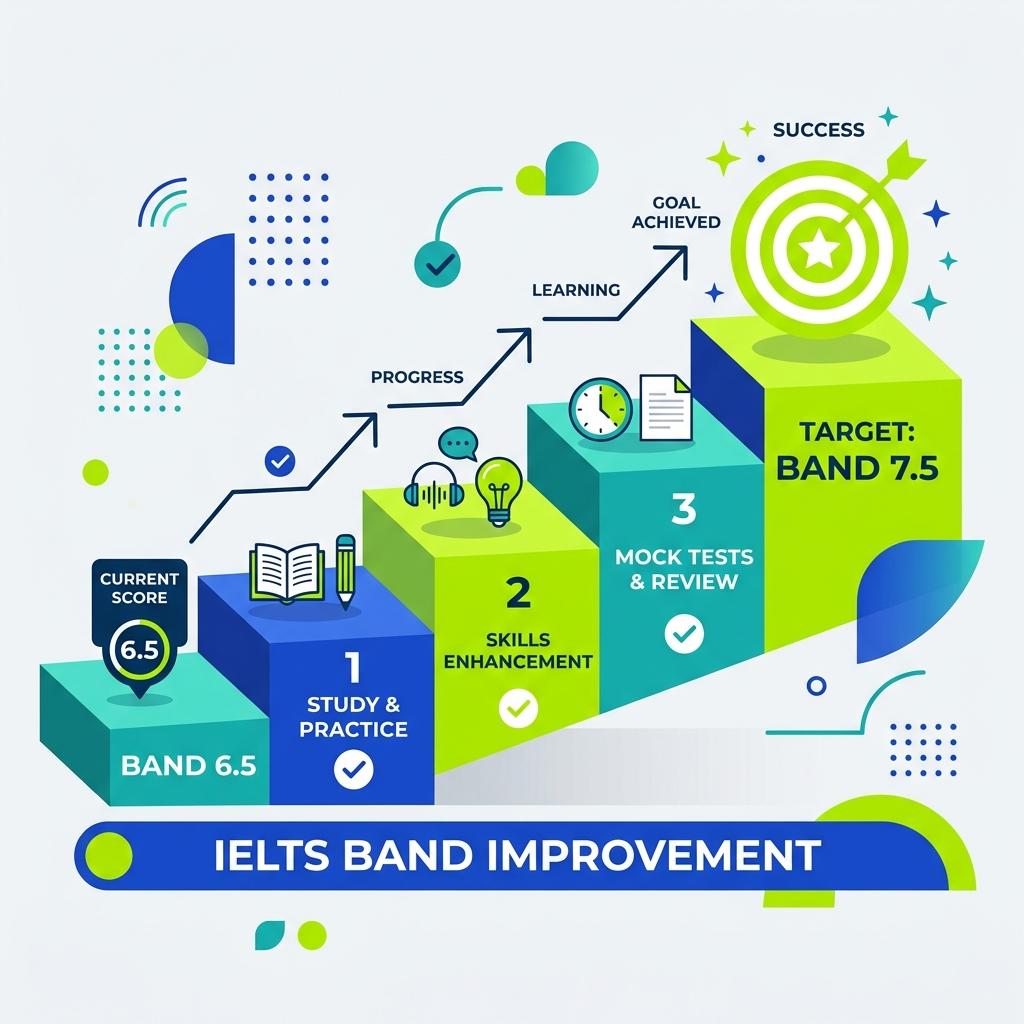
Everyone wants to know how to get band 9 in IELTS Speaking. Very few guides explain what a band 9 actually is. It is not "sounding like a native speaker". It is not "using lots of idioms" either. IELTS speaking band 9 means meeting four specific public criteria at the top level, consistently, for 11 to 14 minutes.
This guide works from those criteria. You will see what separates band 7, band 8 and band 9, with sample answers, plus practical IELTS speaking band 9 tips you can train. Band 9 is rare, and it's fine to aim for 8 and let 9 happen. Either way, the path is the same.
How IELTS Speaking is scored
Before any IELTS speaking tips for band 9 (or tips for IELTS speaking band 9 from friends and forums), you need to know how IELTS speaking is scored. A trained human examiner listens to your whole test and gives a band from 0 to 9 on each of four criteria:
- Fluency and coherence: how smoothly and logically you speak
- Lexical resource: the range and precision of your vocabulary
- Grammatical range and accuracy: the variety and correctness of your structures
- Pronunciation: how easy you are to understand, and how well you use stress, rhythm and intonation
That is how IELTS speaking score is calculated. The four criteria carry equal weight, and they are averaged into your Speaking band, reported in whole or half bands. It is also how IELTS speaking score is evaluated: across the whole test, not per question. One weak answer won't sink you, and one brilliant answer won't save you.
This is the same for Academic and General Training. The IELTS general training speaking band score uses the exact same criteria and test. Want a quick IELTS band score speaking estimate? Try our free band estimator. It works as an IELTS speaking band score calculator based on the public descriptors.
Band 7 vs band 8 vs band 9: the descriptors side by side
Below is a plain-English summary of the public IELTS speaking band descriptors at the top three levels. Read it as an IELTS speaking band score chart: each column is what the examiner is listening for. For every criterion explained in depth, read our IELTS speaking band descriptors explained guide.
| Criterion | Band 7 | Band 8 | Band 9 |
|---|---|---|---|
| Fluency & coherence | Speaks at length without noticeable effort; some language-related hesitation or repetition | Fluent; only very occasional repetition or self-correction; hesitation mostly about content | Fluent with only very occasional repetition; any hesitation is to plan ideas, not to find words; fully coherent, well-developed topics |
| Lexical resource | Flexible vocabulary; some less common and idiomatic items; aware of style and collocation, some errors | Wide resource used readily; skilful use of less common and idiomatic items with occasional inaccuracy | Total flexibility and precision in all contexts; natural, accurate idiomatic language |
| Grammatical range & accuracy | Range of complex structures used with some flexibility; frequent error-free sentences | Wide range of structures used flexibly; the majority of sentences error-free | Precise, accurate structures throughout, apart from slips a native speaker would also make |
| Pronunciation | Shows all positive features of band 6 and some of band 8 | Wide range of features; easy to understand throughout; accent has minimal effect | Full range of features used to convey subtle meaning; effortless to understand; accent has no effect on intelligibility |
Compared with the band 8 column, the IELTS speaking band 9 descriptors ask for consistency more than novelty. Two things stand out:
- Band 9 never mentions a native accent. The IELTS speaking band 9 perfect pronunciation people talk about is really effortless intelligibility. See does accent affect your IELTS speaking score?
- The jump from 8 to 9 is about consistency. Band 8 allows "occasional inaccuracies". Band 9 is precise all the time.
This is also why band 6 vs band 8 is such a big gap. It is not two extra "levels" of vocabulary. It is a different relationship with the language: a band 6 speaker searches for words, while a band 8 speaker chooses between them.
What band 7 and band 8 actually mean
IELTS band 8 meaning: you are a "very good user". You handle complex language well, with occasional inaccuracies in unfamiliar situations. The IELTS speaking band 8 criteria in the table show it: wide, flexible range, mostly error-free.
IELTS speaking band 7 ("good user") is where most university and visa requirements sit. The IELTS speaking band 7 description is about effortless length: you speak at length without noticeable effort, even if some errors remain. If you're currently between 6 and 7, start with our IELTS speaking band 6 to 7 guide before chasing 9. IELTS speaking band 7 tips differ from band 9 tips mainly in consistency and precision.
So what is a good IELTS score? It depends on your goal. Band 7 IELTS speaking meets most professional registrations and top universities. An IELTS speaking band score 7 is the common target. An IELTS speaking band score 8 or higher gives you headroom. An IELTS speaking band score 9 is exceptional, a sign of complete command. Aim for the IELTS speaking band score your goal requires, plus a 0.5 buffer.
IELTS speaking band 9 example: the same question at three levels
Here is one Part 3 question answered at three levels. These are illustrative IELTS speaking band 9 samples, written to match the descriptors, not transcripts of real candidates.
Question: "Do you think people rely too much on technology today?"
IELTS speaking band 7 example: "Yes, I think people rely on technology too much nowadays. For example, many people can't remember phone numbers because they save everything in their phones. But technology also helps us a lot, so it's not completely negative."
Band 8 answer (like most IELTS band 8 examples): "To some extent, yes. The clearest sign is how little we memorise now. Most people couldn't recite a friend's number if their phone died. That said, I'd distinguish between reliance and dependence. Relying on a calculator is sensible; not being able to find your way home without GPS is more worrying."
IELTS speaking band 9 sample answer: "I'd say it depends on what we're outsourcing. Offloading routine memory, like phone numbers or directions, is arguably just efficient. It frees up attention for more complex things. What concerns me more is when we outsource judgement: letting recommendation algorithms decide what we read, or trusting a navigation app over our own sense of a road. That's less about technology itself and more about whether we're still the ones making the decisions."
What makes the last one an IELTS speaking band 9 example?
- Coherence: it builds an argument (routine memory vs judgement) instead of listing points.
- Precision: "offloading", "outsourcing judgement" and "arguably" are exact, not decorative.
- Grammar: a range of structures ("What concerns me more is when…", a relative clause, a gerund subject), used without strain.
- Natural length: long enough to develop the idea, with no filler.
Note what it doesn't have: forced idioms. Most IELTS band 9 sample answers and IELTS band 9 examples online overuse idioms. The descriptors reward idiomatic language that is natural and accurate. More band 9 speaking samples and IELTS speaking band 9 sample answers are in our Part 3 abstract topics guide, which also has IELTS speaking Part 3 sample answers.
How to score band 9 in IELTS: criterion by criterion
Here is how to score band 9 in IELTS Speaking, one criterion at a time. These are the IELTS speaking tips and tricks that actually move scores, as opposed to general IELTS speaking tips that only teach the format.
1. Fluency and coherence in IELTS speaking
Fluency and coherence at band 9 means hesitating only to think about what to say, never how. What is fluency in speaking? It is not speed. It is the absence of language-related pauses. A slow, thoughtful speaker can score higher than a fast one who keeps restarting sentences.
How to improve fluency in IELTS speaking:
- Build automaticity with repetition. Answer the same question five times in a row. By the fifth attempt, the language stops needing conscious effort.
- Use discourse markers to organise, not to fill. "That said…", "What I'd add is…" and "The main reason is…" signal structure. This is the "IELTS speaking better connectors better fluency" idea done properly.
- Develop, don't list. Coherence at the top bands means one idea explored, not five mentioned.
Our full guide on how to improve IELTS speaking fluency has drills, and a week of IELTS speaking fluency practice: how to improve IELTS speaking fluency. It also covers fluency and coherence in IELTS speaking in more depth. If you want a general English fluency test speaking benchmark, or advice on how to get fluency in English speaking beyond the exam, it covers that too.
2. Lexical resource: precision beats rarity
Lexical resource at band 9 is "total flexibility and precise use". The key word is precise. IELTS speaking high band words are not obscure words. They are the exact word for your meaning:
| Instead of | Try (when accurate) |
|---|---|
| very important | crucial, essential, a priority |
| bad for health | harmful, detrimental, takes a toll on |
| a lot of people think | it's widely assumed that |
| it is good and bad | it's a double-edged sword |
Lists like Cambridge vocabulary for IELTS band 7, words for IELTS band 7 and vocabulary for IELTS band 8 are useful for input. But vocabulary for IELTS speaking only counts when you can use it correctly under pressure. The same goes for IELTS speaking vocabulary band 9 lists.
On idioms: IELTS speaking idioms for band 9 and idioms for IELTS band 9 only help when used naturally and correctly. IELTS speaking idioms for band 7 work the same way: one natural idiom beats five forced ones. Our list of IELTS speaking common idioms, with guidance on when to use them, is in IELTS speaking idioms and phrases.
Lexical resource grammatical range go hand in hand. Precise vocabulary needs flexible structures to carry it, and that is why coherence lexical resource and grammar are marked separately but improve together.
3. Grammatical range and accuracy
Grammatical range and accuracy at band 9 means precise structures at all times, apart from slips a native speaker might also make. Practically:
- Use a range of structures naturally: conditionals ("If I'd known…"), relative clauses, passives, cleft sentences ("What I find interesting is…").
- Keep complex sentences error-free. At band 7 you are allowed errors in complex structures. At band 9 you aren't.
- Don't force complexity. A simple, correct sentence is better than a complicated broken one.
4. IELTS speaking pronunciation
IELTS speaking pronunciation at band 9 means using "a full range of phonological features to convey precise and subtle meaning". The IELTS speaking pronunciation features examiners listen for are:
- Word and sentence stress: stressing the right syllable (PHOtograph, phoTOGraphy) and the key word in a sentence.
- Intonation: rising and falling pitch to signal questions, contrast, certainty or doubt.
- Connected speech: linking words naturally ("wha-tif", not "what. if.").
- Chunking: pausing between ideas, not in the middle of them.
So what is good enough pronunciation for a high band? You must be effortlessly understood, with your accent having no effect on intelligibility. That is a clarity target, not an accent target. For focused IELTS speaking pronunciation practice and general English pronunciation work, Sprechify's phoneme-level pronunciation coaching flags the exact sounds that make listeners work harder. Band 8 and 9 speakers show IELTS speaking perfect pronunciation and fluency together: clear sounds, delivered smoothly.
Find out which criterion is holding you back.
Sprechify's live AI examiner scores every answer on all four criteria, so you know whether your ceiling is fluency, vocabulary, grammar or pronunciation. No more guessing.
Take an AI mock testBand 9 tips for each part of the test
Band 9 needs different things in each part. The IELTS speaking Part 1, IELTS speaking Part 2 and IELTS speaking Part 3 sections test the same criteria in different settings.
Part 1: answer, extend, stop. Band 9 in Part 1 sounds relaxed and natural, never rehearsed. See our Part 1 questions and answers guide.
Part 2: IELTS speaking Part 2 tips for the top band:
- Use the full minute of preparation to plan a story, not a list of notes.
- Speak for close to the full two minutes. Running out at 60 seconds limits your fluency score.
- Include a reflection ("Looking back, what strikes me is…"). It naturally brings out complex grammar and precise vocabulary.
More in our cue card strategies guide.
Part 3: IELTS speaking Part 3 tips: this is where band 8 and 9 are won. Examiners push you into advanced topics for speaking: society, technology, education, the future. Band 9 answers weigh both sides, qualify claims ("to some extent", "arguably") and speculate ("It's likely that…"). See mastering abstract discussions.
What band 9 is not
- It's not sounding like a native speaker. Native speaker accent is not a criterion. Clarity is.
- It's not memorised answers. Examiners are trained to spot memorised language, and it counts against you.
- It's not speaking fast. Speed without control lowers fluency scores.
- It's not using the "hardest" word. Precision beats rarity every time.
Band 9 prep: a 4-week plan
This band 9 prep plan assumes you're already around band 7 and want to know how to improve IELTS speaking score to 8–9.
| Week | Focus | Daily practice (20–30 min) |
|---|---|---|
| 1 | Diagnose | One full IELTS speaking mock test; identify your weakest criterion |
| 2 | Weakest criterion | Targeted drills (fluency, vocabulary, grammar or pronunciation) |
| 3 | Part 3 depth | 5 abstract questions a day; develop one argument per answer |
| 4 | Simulation | Full mocks every other day under real timing; review each recording |
The most useful tool is honest feedback on every attempt. That can come from a teacher, a recording you review critically, or an AI IELTS speaking examiner. Sprechify's AI examiner runs full IELTS speaking test simulations under real timing, and scores each answer against the descriptors. That gives your IELTS speaking practice a clear target every day. The free band estimator shows your starting point without an account.
If you are comparing a free IELTS speaking mock test with score or an IELTS practice test online with score, check what the score is based on. See how accurate are AI IELTS speaking scores?
Final tips for high band scores
These final tips to maximize speaking score are the expert tips in IELTS speaking that matter most on the day:
- Answer the question first, then develop it.
- Be precise, not impressive. Use the exact word, not the longest one.
- Show range naturally. Use a mix of tenses and structures because the answer needs them.
- Pause to think, not to search. A thinking pause sounds fine; a word-search pause does not.
- Treat the examiner as a person. Band 9 sounds like a conversation, not a performance.
These are the final tips for high band scores we'd give any candidate. Read them with the speaking band descriptors table above. Together they are a complete picture of the IELTS speaking band criteria, and what each speaking score level means.
FAQ
Is band 9 in IELTS Speaking possible for non-native speakers? Yes. The band descriptors never require a native accent or native background. Band 9 requires precise, flexible, effortlessly understood English.
Where can I find the official IELTS speaking band score descriptors? The public IELTS speaking band score descriptors are published by the IELTS partners (British Council, IDP and Cambridge). Our descriptors explained guide summarises them in plain English, alongside an IELTS band score chart for speaking.
What IELTS band score for speaking do universities need? Most ask for an IELTS band score for speaking of 6.0–7.0. Check each university's own requirement. Some courses and professional registrations ask for more.
Is there a band score chart for the whole test? Yes. The overall band score chart averages all four skills. Most people check an IELTS speaking score description or a band score calculator IELTS tool for their section scores. When comparing band scores, remember that each section is scored separately.
Can AI help me get band 9? AI is useful for volume (unlimited practice) and consistent feedback on all four criteria. The final judge is always a human examiner. Use AI to practise. Don't treat its estimate as a guarantee.
Next steps: get your free band estimate, see how Sprechify works, or compare plans. Every paid plan comes with a 30-day money-back guarantee.