IELTS Speaking Band 5.5 to 6.5: What Changes & How
What separates IELTS Speaking Band 5 from Band 6 on each criterion, the habits that keep candidates at 5.5, and a 6-week plan to reach 6.5.
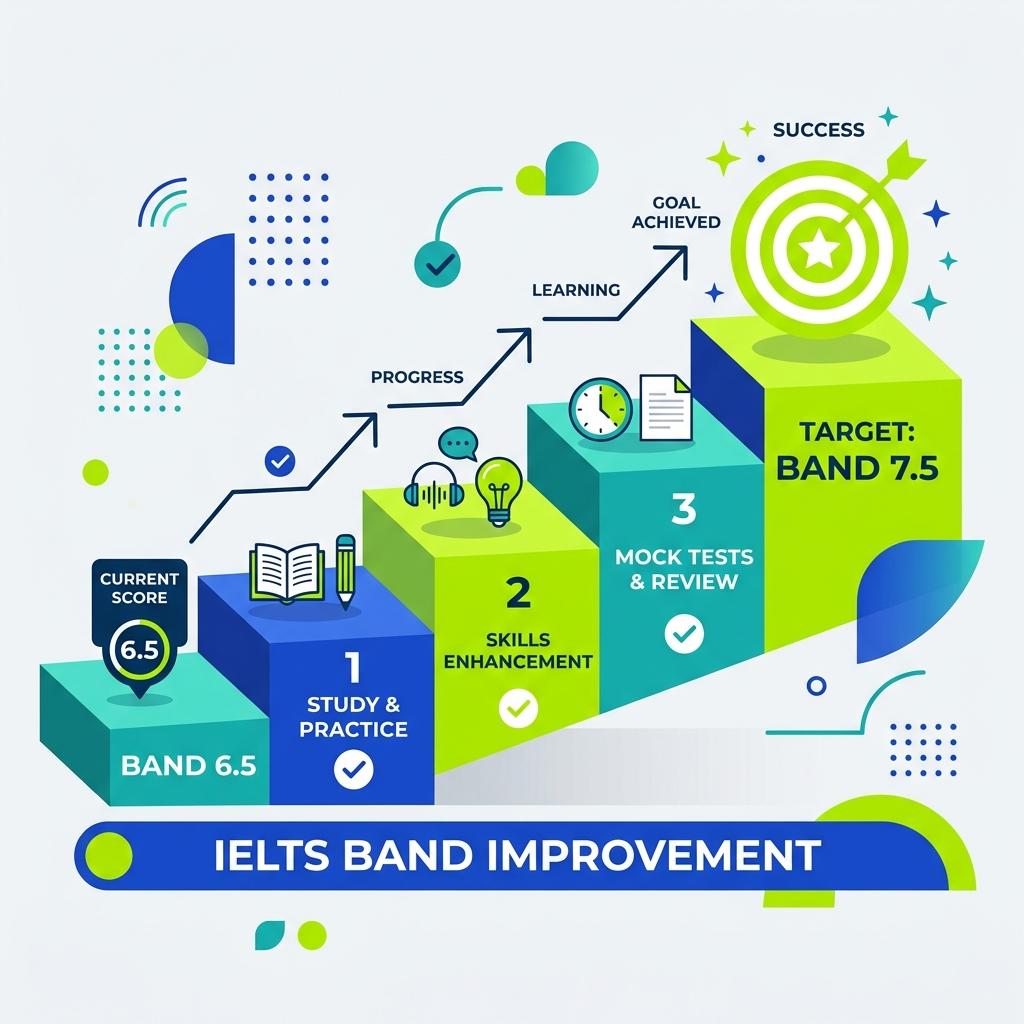
If you're at Band 5.5 in IELTS Speaking and need 6.0 or 6.5, the good news is that the step is usually about a few specific habits, not your whole level of English. The descriptors for Band 5 and Band 6 differ in clear, practical ways. This guide shows what changes on each criterion and gives you a six-week plan.
How a 5.5 or 6.5 happens
The examiner scores four equally weighted criteria: Fluency and Coherence, Lexical Resource, Grammatical Range and Accuracy, and Pronunciation. Your Speaking band comes from all four together. So a 5.5 usually means some criteria at 5 and some at 6, and a 6.5 usually means a mix of 6s and 7s. You don't need to improve everything. Find your weakest criterion and lift it.
Band 5 vs Band 6, criterion by criterion
Summarised from the public IELTS Speaking Band Descriptors:
Fluency and Coherence
- Band 5: keeps speech going but relies on repetition, self-correction or slow speech. May overuse certain linking words. Simple speech is fluent, but more complex communication causes fluency problems.
- Band 6: "willing to speak at length", though it may lose coherence at times. Uses a range of linking words, "but not always appropriately".
- What to change: give longer answers, even imperfect ones. Moving from short, careful answers to longer, developed ones is the biggest single shift from 5 to 6.
Lexical Resource
- Band 5: can talk about familiar and unfamiliar topics but with limited flexibility. Paraphrase is attempted "with mixed success".
- Band 6: "a wide enough vocabulary to discuss topics at length and make meaning clear in spite of inappropriacies". "Generally paraphrases successfully."
- What to change: when you don't know a word, describe it instead of stopping. "It's a kind of… the thing you use to…". That's paraphrase, and it keeps you talking.
Grammatical Range and Accuracy
- Band 5: basic sentences are reasonably accurate. A limited range of complex structures, which usually contain errors.
- Band 6: "a mix of simple and complex structures, but with limited flexibility". Mistakes with complex structures "rarely cause comprehension problems".
- What to change: use some complex sentences (because, although, if, who/which) in every answer, and keep them understandable. See IELTS Speaking grammar.
Pronunciation
- Band 5: positive features of Band 4 and some, but not all, of Band 6.
- Band 6: "can generally be understood throughout", though mispronouncing individual words or sounds "reduces clarity at times".
- What to change: work on the specific sounds and word stress that make you hard to follow, not on your accent. See does accent affect your IELTS Speaking score?
The habits that keep candidates at 5.5
- One-sentence answers in Part 1: "Yes, I like it." Add a reason and an example every time.
- Stopping early in Part 2, often after 40–60 seconds. Use a simple structure to fill two minutes. See Part 2 cue cards.
- Very short Part 3 answers. Give an opinion, a reason and an example. See Part 3 questions and answers.
- Freezing when you don't know a word, instead of paraphrasing.
- Translating in your head sentence by sentence, which slows you down and breaks the flow.
- Memorised answers. They sound rehearsed, and they break down when the question is slightly different.
A 6-week plan from 5.5 to 6.5
Aim for at least 20–30 minutes of speaking out loud every day.
Week 1: find your weakest criterion
- Record a full mock test under real timing (Parts 1, 2 and 3).
- Listen back against the four criteria. Which one sounds most like the Band 5 description above?
Week 2: longer Part 1 answers
- Answer ten Part 1 questions a day, each with a reason and an example (about three sentences).
- Use Part 1 questions and answers for topics.
Week 3: the full two minutes in Part 2
- One cue card a day, timed: 1 minute of notes, then talk until the time is up.
- Record it and note where you stopped or repeated yourself. Then do the same card again.
Week 4: developed Part 3 answers
- Five Part 3 questions a day using answer, reason, example.
- Include at least one complex sentence in each answer.
Week 5: paraphrase and vocabulary range
- Practise describing words you don't know instead of stopping.
- Replace your three most-repeated words ("good", "very", "important") with more precise choices.
Week 6: full mocks
- Three full mock tests under timing. Compare against your Week 1 recording.
- No new material in the final two days. Just speak every day, lightly.
FAQ
How long does it take to go from 5.5 to 6.5 in Speaking? It depends on your starting point and how much you practise speaking out loud. Six weeks of daily speaking practice is a realistic plan for many candidates. Some need longer.
What is the fastest way to improve from Band 5.5? Speak at length. Moving from short, careful answers to longer, developed answers affects Fluency and Coherence most directly, and it gives the examiner more language to assess on the other criteria.
Is Band 6 enough for my visa or university? Requirements vary, often by skill as well as overall. Check your exact requirement with the organisation.
Practise every day with a live tutor
Sprechify is a live voice AI tutor built only for IELTS Speaking. It holds two-way conversations through Parts 1, 2 and 3, corrects you one fix at a time, and gives feedback on all four Band Descriptors, so you can see which criterion is holding you at 5.5. See the 30-day course. Treat its band as a practice estimate; only the real test gives an official score.
Related reading: IELTS Speaking Band 6 to 7 · IELTS Speaking Band Descriptors Explained · Common IELTS Speaking mistakes